
Honduran Pastelitos (Crispy Corn Empanadas with Beef, Beans or Cheese)
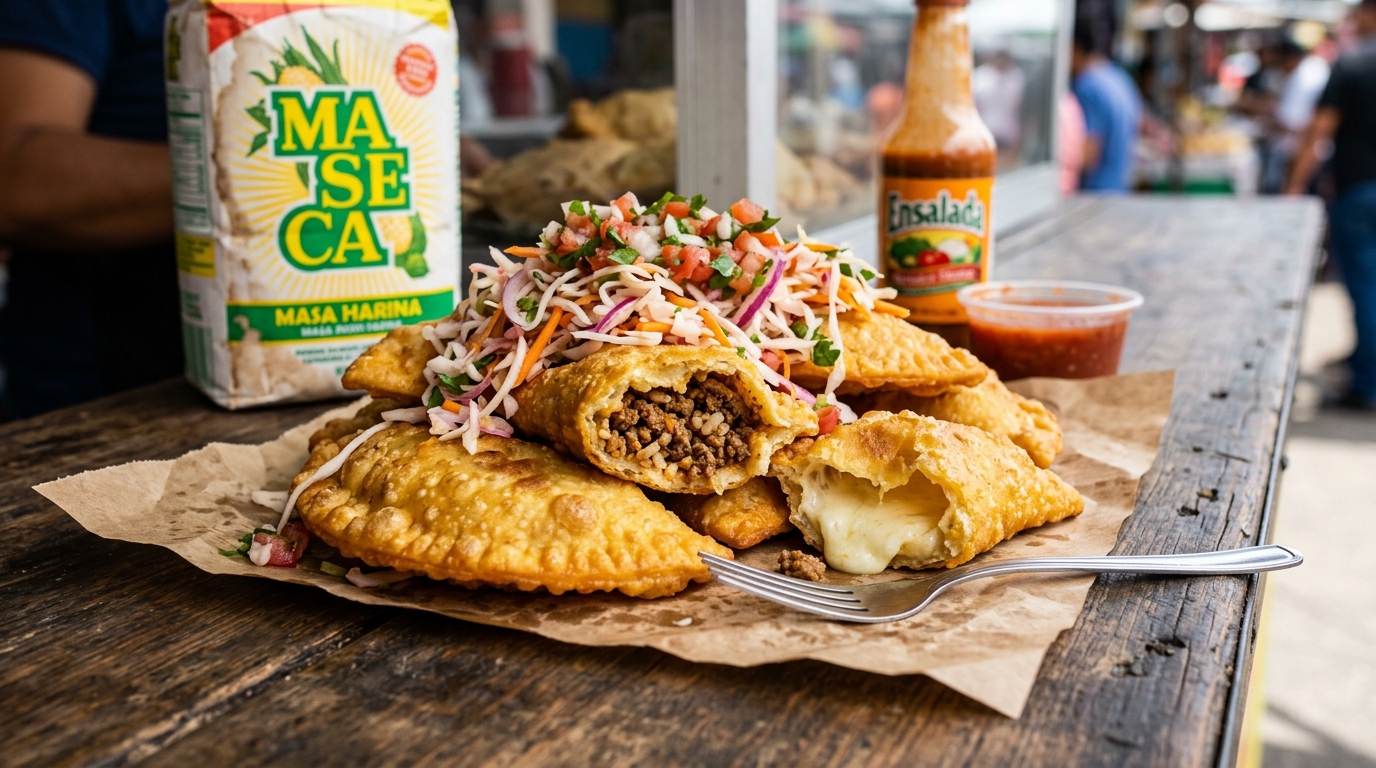
Walk any street in Tegucigalpa or San Pedro Sula from seven in the morning to late at night and someone is frying Honduran pastelitos: half-moons of thin corn dough, crackling and golden, stuffed with spiced ground beef and rice, or refried red beans, or cheese that stretches when you break one open. They come in a paper bag with a pile of pickled cabbage and a spoonful of chimol on top, and they cost less than a dollar. Every Honduran I know in the US has a story about the first thing they cooked when they got homesick, and it's usually these.
This is the from-scratch version for an American kitchen: Maseca from any supermarket, the three classic fillings, the dough hydration that keeps them from cracking in the oil, and the sealing trick that keeps the filling in. I've fried a lot of these — a lot of them badly, early on — so the tips below are the ones that actually fix things. For the rest of the site in English, see the recipes in English page.
What are Honduran pastelitos?
Fried corn-dough empanadas — but don't say "empanada" to a Honduran. In Honduras pastelitos are specifically the street version: a thin shell made from nixtamalized corn flour (masa harina), folded over a filling, crimped with a fork and deep-fried until blistered and crisp. The classic filling is carne — ground beef cooked down with onion, tomato, green pepper, cumin and achiote, usually stretched with a little cooked rice and sometimes potato. Frijoles (thick refried red beans) and queso (Honduran quesillo or a salty white cheese) are the other two you'll see at every stand. They are always served with repollo — a quick vinegary cabbage slaw — and chimol, the Honduran tomato-onion-cilantro salsa, and eaten with your hands.
They're cousins of the Salvadoran pastelitos (which lean more on potato) and the Colombian corn empanada, but the Honduran shell is thinner and the beef-and-rice filling is the tell.
The ingredients, US edition
- Masa harina — Maseca is in the baking or Hispanic aisle of every Walmart, Kroger and Publix. Not cornmeal, not corn flour from the baking aisle; it has to say masa or nixtamalized.
- Cheese: Honduran quesillo or queso seco if you're near a Central American market (Olanchito, La Chona and Cacique's queso duro are common brands). Otherwise a 50/50 mix of low-moisture mozzarella (for the stretch) and queso fresco (for the salt) is very close.
- Beans: Honduran refried beans are made from small red beans (frijoles rojos, "red silk"), not pinto. Goya and Ducal sell canned frijoles rojos volteados; any refried red bean works. They must be thick — cook a loose can down in a skillet until it holds a line when you drag a spoon through it.
- Achiote / sazón: a packet of Goya sazón con achiote, or a teaspoon of achiote powder, gives the beef its orange color.
- Chimol is just diced tomato, onion, green pepper, cilantro, lime and salt — make it while the dough rests.
More recipes like this
Honduran Pastelitos (Crispy Corn Empanadas with Beef, Beans or Cheese)
Honduran pastelitos: a thin masa harina shell fried crisp around seasoned ground beef and rice, refried red beans, or melting cheese, served with cabbage slaw and chimol. Street food you can make with a bag of Maseca.
Ingredients
Instructions
- Make the dough: stir the masa harina and salt together, then work in the warm water a little at a time with your hands until it comes together into a soft, smooth dough that doesn't stick to your palm and doesn't crack when pressed — like soft Play-Doh. Knead in the lard or oil. Cover with a damp towel and rest 15 minutes.
- Make the beef filling: heat the oil over medium, cook the onion and garlic 2 minutes, add the beef and brown it, breaking it up, until no pink remains. Add the tomato, green pepper, cumin, sazón, salt and pepper and cook 8–10 minutes until the vegetables are soft and the pan is dry. Stir in the rice if using. Cool completely. (For bean or cheese pastelitos, skip this and use the alternative fillings.)
- Shape: divide the dough into 20 balls (about the size of a golf ball). Press each between two sheets of plastic in a tortilla press, or under a heavy skillet, into a 5-inch round about ⅛ inch thick.
- Fill and seal: put about 1½ tablespoons of filling slightly off-center, leaving a ½-inch border. Fold the dough over into a half-moon, press the edge closed with your fingertips, then crimp firmly all along the edge with a fork. Keep the finished ones under a towel.
- Fry: heat 2 inches of oil to 350°F in a deep skillet or pot. Fry 3–4 at a time, 2–3 minutes per side, until golden, blistered and crisp. Drain on a rack.
- Serve hot with the cabbage slaw, chimol and hot sauce.
Other recipes to try
Tips
Tips from my kitchen
- Dough on the dry side. It should feel like soft Play-Doh: it holds a ball, doesn't stick to your palm, and doesn't crack when you press it. Wet dough tears in the fryer and the filling leaks out — that was my first twenty pastelitos. If it cracks at the edges when you fold, wet your hands and knead in a teaspoon of water at a time.
- Rest the dough 15 minutes under a damp towel. Masa harina keeps absorbing water; a rested dough is noticeably easier to press.
- Press, don't roll. A tortilla press lined with a cut zip-top bag gives you an even thin round in one squeeze; if you don't have one, a heavy skillet or a plate pressed on the ball between two pieces of plastic works. Aim for a 5-inch round, about ⅛ inch thick.
- The filling must be dry and cool. Any moisture turns to steam and blows the seam open. Cook the beef until there's no liquid in the pan, and let it cool before filling.
- Don't overfill — about 1½ tablespoons. Leave a ½-inch border, fold, press the edge with your fingers, then crimp with a fork. The fork is structural, not decorative.
- Oil at 350°F. Too cool and they soak up grease; too hot and the shell browns before the dough cooks through. No thermometer: a pinch of dough should sizzle immediately and float in a few seconds. Fry 2–3 minutes per side in batches of 3–4; don't crowd the pot.
- Drain on a rack, not paper towels, so the bottoms stay crisp.
Variations
- Pastelitos de carne (the classic): the beef filling below, stretched with ½ cup cooked rice and, if you like, ½ cup diced boiled potato — that's how the street stands do it.
- Pastelitos de frijol: 1½ cups thick refried red beans, with or without a pinch of cheese. The easiest and the kids' favorite.
- Pastelitos de queso: 2 cups shredded quesillo or the mozzarella–queso fresco mix. Seal these extra carefully; melted cheese finds any gap.
- Chicken: shredded cooked chicken sautéed with the same onion-tomato-cumin base.
- Baked / air fryer: brush with oil and bake at 400°F for 18–20 minutes, or air-fry at 375°F for 12 minutes, flipping once. Crisp but not blistered — a good weeknight compromise.
- Make-ahead: assemble, freeze on a tray, then bag. Fry from frozen, adding about 2 minutes.
Nutrition facts
Per serving
makes 20| Calories | 150 | |
| Protein | 5g | |
| Carbohydrates | 12g | |
| Fat | 9g | |
| Fiber | 1g | |
| Sodium | 190mg |
Keywords: honduran pastelitos recipe, honduran pastelitos, pastelitos hondureños, pastelitos de carne, honduran empanadas, masa harina empanadas, honduran food
Did you make this recipe?Rate it and tell me how it turned out in the comments.
How to serve Honduran pastelitos
Hot, with a heap of repollo (shredded cabbage tossed with white vinegar, a little water, salt, oregano and a pinch of sugar, left 20 minutes), a spoonful of chimol and a few dashes of hot sauce. Many Hondurans add a drizzle of crema or a sprinkle of dry cheese over the slaw. They're a snack, a party tray, or — three of them with the slaw — lunch. Beer or a cold horchata alongside.
Frequently asked questions
What is the difference between Honduran pastelitos and empanadas?
Honduran pastelitos are made with a thin nixtamalized-corn (masa harina) shell and deep-fried until blistered; most empanadas use a wheat-flour pastry and are baked or fried. The beef-and-rice filling and the cabbage slaw on top are distinctly Honduran.
Why do my pastelitos crack or burst when frying?
Three causes: the dough is too wet (tears) or too dry (cracks at the fold), the filling is wet (steam), or the edge isn't sealed. Dough like soft Play-Doh, a dry cooled filling, and a fork crimp fix all three.
Can I use corn flour or cornmeal instead of masa harina?
No — they don't form a dough. It has to be nixtamalized corn flour: Maseca, Bob's Red Mill masa harina, or any bag that says masa.
What cheese do Hondurans use in pastelitos?
Quesillo (a mild melting cheese) or a salty dry white cheese. In the US, a mix of low-moisture mozzarella and queso fresco gets you close; Oaxaca cheese also works.
Can I bake them instead of frying?
Yes — 400°F for 18–20 minutes, brushed with oil, or 12 minutes in an air fryer at 375°F. They'll be crisp but without the blistered, bubbly shell frying gives.
How do I store and reheat leftovers?
Refrigerate up to 3 days; reheat in a 375°F oven or air fryer 6–8 minutes so the shell re-crisps. The microwave makes them soft.
One last thing
Once you've pressed a few, a batch of twenty takes an hour and disappears in ten minutes. If you make them, leave a rating below and tell me which filling won at your table — in my house it's beef by a mile, but the cheese ones never make it to the table.
0 comments