
Salvadoran Quesadilla (Sweet Cheese Pound Cake)
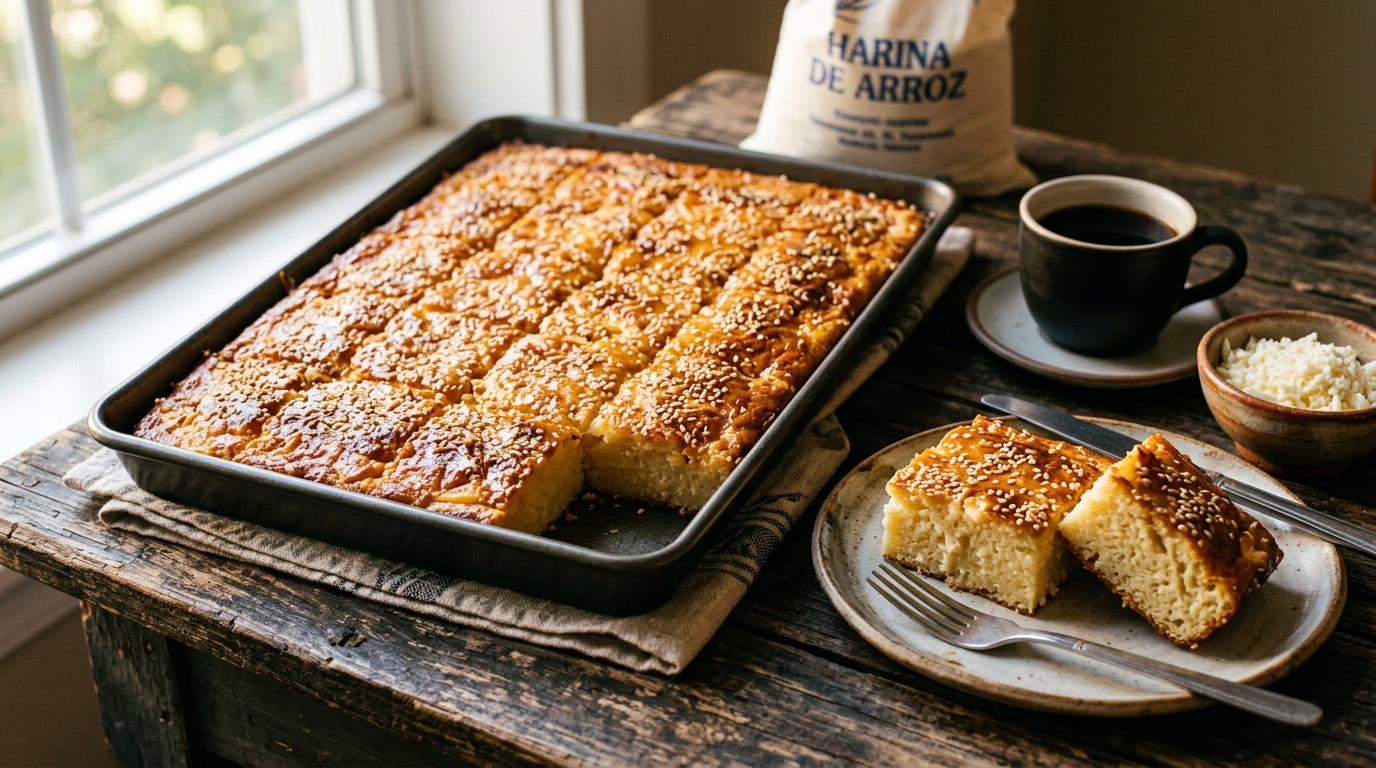
First things first: a Salvadoran quesadilla has nothing to do with a tortilla. It's a cake — a dense, buttery, faintly sweet pound cake made with rice flour, eggs, sour cream and a salty Central American cheese, baked in a sheet pan with sesame seeds on top and cut into squares. In El Salvador it's the bread of the afternoon coffee: every panadería sells it, every pupusería in Los Angeles and Houston and DC has a tray by the register, and every Salvadoran abroad has a relative who mails it in foil. It's the dessert that surprises Americans most — "it's a quesadilla?" — and the one they ask for the recipe for.
This is the version I bake at home in the US, with the cheeses you can actually find, the rice-flour question settled, and the reason so many homemade quesadillas come out dry (it's the baking time, not the recipe). For everything else on the site in English, see the recipes in English page.
What is a Salvadoran quesadilla?
A sweet cheese bread, somewhere between a pound cake and a cornbread in texture: tight, moist crumb, golden crust, a nutty crunch of sesame on top. The name comes from the cheese — queso — the way the Mexican one does, but the dishes are unrelated; the Salvadoran quesadilla is closer to a Spanish quesada. Traditionally it's made with rice flour (harina de arroz), which gives the characteristic fine, slightly sandy crumb, and with queso duro blando or queso seco, the salty aged white cheeses of the region, balanced by sugar and crema. You eat it at breakfast or at 4 pm with black coffee, never as a plated dessert.
Ingredients, US edition
- Rice flour: Goya and Bob's Red Mill rice flour are in the Hispanic or gluten-free aisle of most supermarkets; Asian markets sell it by the bag for a dollar. It's what makes the crumb right. All-purpose flour works — the cake is softer and more like a regular pound cake.
- The cheese is the flavor. Best: Salvadoran queso duro blando or queso seco (Olanchito, Petacones, La Chona — any Central American market, and most Latin markets in Salvadoran neighborhoods). Good substitutes, in order: cotija, grated Parmesan, or queso fresco with an extra pinch of salt. Parmesan is the one most Salvadoran-American families use now, and nobody complains.
- Crema: Salvadoran crema (Olanchito, Cacique crema salvadoreña) if you can; full-fat sour cream otherwise — it's very close.
- Sesame seeds on top are not decoration; they toast in the oven and are half the flavor.
- Butter — real, unsalted. A lot of it. This is not a light cake.
More recipes like this
Salvadoran Quesadilla (Sweet Cheese Pound Cake)
Salvadoran quesadilla: not a tortilla — a rich, tender cheese-and-sour-cream cake made with rice flour, topped with sesame seeds, eaten with coffee. The cheeses to use in the US, and the one mistake that makes it dry.
Ingredients
Instructions
- Heat the oven to 350°F. Grease a 9×13-inch metal baking pan and dust it with rice flour (or line with parchment).
- Dry ingredients: whisk the rice flour, sugar, baking powder and salt in a large bowl.
- Wet ingredients: in another bowl, whisk the eggs, then whisk in the sour cream, milk, melted butter and vanilla until smooth. Stir in the grated cheese.
- Combine: pour the wet mixture into the dry and stir just until no dry streaks remain — it's a thick, pourable batter. Taste a little: it should be sweet with a salty edge; adjust salt if your cheese is mild.
- Pan and top: scrape into the pan, smooth the top, and scatter the sesame seeds evenly over it, pressing very lightly so they stick.
- Bake 30–35 minutes, until golden and a toothpick in the center comes out with a few moist crumbs — don't wait for it to be bone-dry. Glass pans need about 5 minutes more.
- Cool in the pan 20 minutes, then cut into squares or diamonds. Serve warm or at room temperature with coffee.
Other recipes to try
Tips
Tips from my kitchen
- Don't over-bake — the classic quesadilla mistake. The first three I made were dry because I waited for a totally clean toothpick. Pull it when the top is golden and a toothpick comes out with a few moist crumbs, 30–35 minutes in a 9×13. It keeps cooking in the pan.
- Room-temperature eggs and sour cream blend into the melted butter smoothly; cold ones seize it into lumps.
- Grate the cheese fine. Fine shreds or a microplane for hard cheese — you want it to disappear into the batter and season everything, not sit in pockets.
- Taste the batter for salt before it goes in. Cheeses vary a lot; cotija and Parmesan are saltier than queso fresco. The batter should taste clearly sweet with a salty edge.
- Sesame on top before baking, pressed in very lightly so it sticks. Add it after and it falls off.
- 9×13 metal pan, greased and floured (rice flour works). Glass needs 5 more minutes and gives a paler crust.
- Let it cool 20 minutes before cutting into squares or diamonds. Warm is perfect; room temperature the next day is arguably better.
Variations
- Classic pupusería style: exactly as below, with cotija or queso duro. Slightly saltier than a dessert cake — that's the point.
- All-purpose flour: swap 1:1. Softer, lighter, more cake-like. Many stateside recipes are written this way.
- Half and half: 1 cup rice flour + 1 cup all-purpose is a good compromise if you're nervous about the rice-flour texture the first time.
- Quesadilla de arroz con queso fresco: the milder version, with queso fresco and an extra tablespoon of sugar.
- Mini quesadillas: a muffin tin, 18–20 minutes, sesame on each — the way they're sold in paper cups at Salvadoran bakeries.
- With a pinch of cinnamon or a teaspoon of vanilla — not traditional everywhere, but common in Santa Ana.
Nutrition facts
Per serving
makes 12| Calories | 300 | |
| Protein | 6g | |
| Carbohydrates | 38g | |
| Fat | 14g | |
| Fiber | 1g | |
| Sodium | 260mg |
Keywords: salvadoran quesadilla recipe, salvadoran quesadilla, quesadilla salvadoreña, salvadoran cheese cake, quesadilla salvadorena recipe, salvadoran desserts, rice flour cheese cake
Did you make this recipe?Rate it and tell me how it turned out in the comments.
How to serve Salvadoran quesadilla
With coffee. That's the whole answer — black coffee or café con leche, mid-morning or at 4 pm, a square on a napkin. It's also breakfast (with a plato típico of beans, eggs and plantains it's the sweet thing on the side), and it shows up at velorios, baptisms and Christmas. It keeps beautifully, which is why it travels in foil across state lines. If you're setting out a Central American spread, put it next to a plate of Honduran pastelitos — sweet and savory, same neighborhood.
Frequently asked questions
Is a Salvadoran quesadilla the same as a Mexican quesadilla?
No. The Mexican one is a tortilla folded over melted cheese. The Salvadoran quesadilla is a sweet, dense cheese cake made with rice flour, eggs, sour cream and salty white cheese, topped with sesame seeds. They share only the word queso.
What cheese is used in Salvadoran quesadilla?
Traditionally queso duro blando or queso seco — salty, aged Central American white cheeses. In the US, cotija or Parmesan are the closest and most common substitutes; queso fresco works with extra salt.
Can I make it with all-purpose flour instead of rice flour?
Yes, 1:1. You'll get a softer, more typical pound-cake crumb. Rice flour gives the finer, slightly sandy texture of the bakery version.
Why is my quesadilla dry?
Over-baked. Pull it when the top is golden and a toothpick shows a few moist crumbs — it finishes cooking in the pan. Too little butter or low-fat sour cream will also dry it out.
Is it a dessert or a bread?
Both and neither — it's a pan dulce, a sweet bread eaten with coffee. It's sweeter than cornbread and saltier than cake.
How long does it keep?
3–4 days covered at room temperature, a week in the fridge, and it freezes well for 2 months in squares. Ten seconds in the microwave brings a cold square back.
One last thing
The first time someone who grew up in San Salvador tastes a square of this and goes quiet for a second, you'll know you got it right. Leave a rating below if you bake it, and tell me which cheese you used — the cotija-versus-Parmesan debate is real.
0 comments